

Local SEO · 29 min read
Gulf Gate's restaurant row: standing out online in Sarasota's densest dining neighborhood
In Gulf Gate, 40+ restaurants compete within six walkable blocks. Proximity doesn't differentiate you anymore. What happens on your Google Business Profile, in your reviews, and in your weekly posting routine decides who gets the tables.
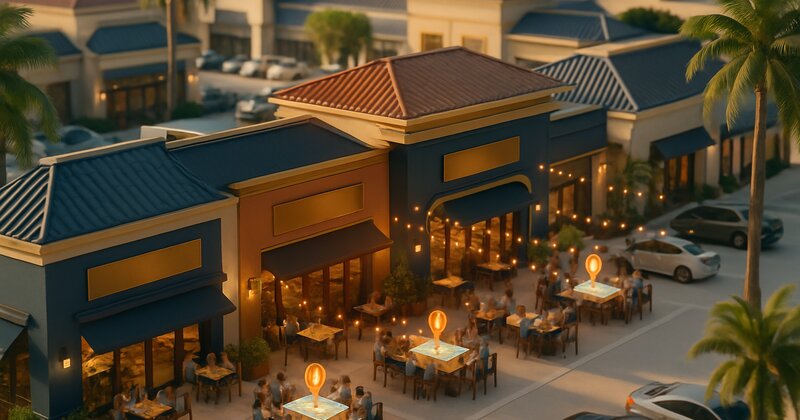
The Gulf Gate Thai restaurant that's booked every Friday while the Italian place next door has empty tables
Two restaurants sit 200 feet apart on Gateway Plaza in Gulf Gate. Both opened in 2019. Both have outdoor seating. Both get decent foot traffic from the Whole Foods and the library crowd.
The Thai place has a 45-minute wait every Friday and Saturday night. The Italian place next door has half-empty dining rooms on the same nights.
The food quality is comparable. The Italian place actually has better Yelp reviews (4.4 stars vs. 4.2 stars for the Thai place). The prices are similar. The locations are identical (same plaza, same parking lot).
So why does one restaurant turn away customers while the other struggles to fill tables?
The Thai restaurant posts on Google Business Profile three times per week. Monday: "Pad See Ew special this week with fresh wide noodles - $13.95 lunch, $16.95 dinner. Available today through Friday." Wednesday: "New spring rolls on the menu - shrimp and pork with mint and cilantro. Come try them this week." Friday morning: "We're fully booked tonight 6-8pm but still have tables at 5pm and after 8:30pm. Walk-ins welcome for lunch until 3pm."
The Thai restaurant responds to every Google review within 24 hours. Five-star review: "Thank you for coming in! We're so glad you enjoyed the Panang curry. See you next time." Three-star review: "Thanks for the feedback about the spice level. We're always happy to adjust heat to your preference - just ask your server next time and we'll make it perfect for you."
The Thai restaurant uploads 2-3 new photos every week. Close-ups of dishes. The chef prepping ingredients. Customers enjoying meals on the patio (with permission).
The Italian restaurant posts on Google Business Profile maybe once a month. Generic posts: "Come enjoy authentic Italian cuisine." No specials, no menu updates, no urgency.
The Italian restaurant responds to reviews occasionally. Maybe 30% get a response, usually a week or two later. The responses are brief: "Thanks!" or "Glad you liked it."
The Italian restaurant has the same 15 photos on their Google Business Profile that they uploaded when they opened in 2019. Half of them are stock photos of pasta dishes that aren't even on their current menu.
When someone in Sarasota searches "Thai food near me" or "restaurants Gulf Gate," Google shows them the map pack (three businesses with map pins). The Thai place appears in position #1 or #2 almost always. The Italian place appears in position #4-6, below the map pack, where 70% of searchers never scroll.
Why? Google's algorithm sees the Thai restaurant as active, engaged, and relevant. Fresh posts, consistent engagement, new photos, responsive to customers. Google sees the Italian restaurant as stale. No activity, minimal engagement, old content.
The Thai owner spends 90 minutes per week on Google Business Profile. Monday morning: write and schedule three posts for the week (30 minutes). Wednesday evening: respond to the week's reviews (20 minutes). Friday morning: upload new photos and check the weekend reservation list (15 minutes). Saturday evening: respond to any reviews that came in over the weekend (25 minutes).
That 90 minutes per week generates an estimated 25-30% of the restaurant's customers. People searching "Thai food Sarasota" or "restaurants near me" or browsing Google Maps looking for dinner options.
The Italian owner spends maybe 15 minutes per month on their Google Business Profile. They don't see the point. They figure good food and word-of-mouth are enough. Meanwhile they're paying $1,200/month for a billboard on I-75 that generates maybe 2-3 customers per month.
Revenue gap: The Thai restaurant does $65,000/month. The Italian restaurant does $38,000/month. Same location, same rent, same foot traffic. The difference is almost entirely online visibility and Google Business Profile activity.
Why Gulf Gate is different from every other Sarasota restaurant cluster
Sarasota has several restaurant-dense areas. St. Armands Circle. Main Street downtown. Siesta Key Village. But Gulf Gate is unique.
Here's what makes Gulf Gate the most competitive restaurant neighborhood in Sarasota:
1. Density without destination appeal
St. Armands Circle is a destination. People drive there specifically to walk the circle and pick a restaurant. Siesta Key Village pulls tourists and beachgoers who are already in the area.
Gulf Gate is a neighborhood plaza. Most diners are locals from surrounding neighborhoods (Gulf Gate, Southside Village, Sarasota Springs, Bee Ridge) deciding where to eat tonight. They're not driving 20 minutes to get to Gulf Gate specifically. They're already within 5-10 minutes and choosing between 40+ options.
That means:
- Proximity doesn't differentiate (every restaurant is equally close)
- Parking and convenience don't differentiate (same parking lots serve all the restaurants)
- Cuisine variety is huge (Thai, Italian, Mexican, sushi, American, Mediterranean, BBQ, Indian, Vietnamese, Chinese, pizza, burgers - you can find everything within six blocks)
The deciding factor: When a local family Googles "dinner near me" or "Mexican food Gulf Gate" at 5:30pm on a Wednesday, which three restaurants show up in the map pack? Those three get considered. The rest are invisible.
2. High turnover and constant new competition
Gulf Gate restaurant spaces turn over every 2-4 years. A sushi place closes, a poke bowl place opens. A burger joint closes, a taco spot opens.
That creates constant competitive pressure. You're not just competing with the Italian place that's been there 15 years. You're competing with the brand-new ramen shop that just opened last month with 5-star reviews and a fresh Google Business Profile.
New restaurants have an advantage in Google's algorithm for the first 3-6 months (Google likes fresh businesses with review momentum). If you've been in Gulf Gate for five years and you haven't posted on Google in six months, the 2-month-old restaurant with 30 new reviews and weekly posts will outrank you.
3. The "food desert" perception problem
Gulf Gate sits between wealthier Sarasota neighborhoods (Southside Village, Sarasota Springs, Gulf Gate Estates) and more working-class areas (Desoto Lakes, Sarasota Springs south of Beneva).
Some Sarasota residents have a dated perception of Gulf Gate as "not a dining destination." They remember the Gulf Gate of the 1990s and early 2000s (more chains, fewer independent restaurants, less appealing).
The reality in 2025: Gulf Gate has some of the best independent restaurants in Sarasota. But perception lags reality by 5-10 years.
Online visibility fights that perception gap. When someone in Southside Village searches "best Thai food Sarasota" and your Gulf Gate restaurant shows up at #1 with 200 five-star reviews and beautiful food photos, you overcome the "I don't think of Gulf Gate for dining" bias.
If your GBP is stale and your reviews are thin, that bias persists and they drive to downtown Sarasota or St. Armands instead.
4. Review volume expectation is higher than other Sarasota neighborhoods
Because Gulf Gate is so restaurant-dense and so local-focused (repeat customers, neighborhood regulars), diners expect to see high review counts.
A Gulf Gate restaurant with 40 reviews looks new or unproven. A Gulf Gate restaurant with 200+ reviews looks established and trustworthy.
Compare that to a restaurant on Siesta Key (where many customers are tourists and one-time visitors). A Siesta Key restaurant can thrive with 80-100 reviews because the customer base is more transient.
In Gulf Gate, you need 150-250+ reviews to be competitive in your category. That takes time and a systematic review collection process (which most Gulf Gate restaurants don't have).
The weekly routine that keeps Gulf Gate restaurants visible (and fully booked)
Let's break down the exact weekly routine that successful Gulf Gate restaurants follow to stay on top of local search and keep tables full.
This routine takes 90-120 minutes per week total. That's less time than most restaurant owners spend scrolling Instagram or arguing with food distributors.
Monday morning: Plan and post the week's specials (30 minutes)
What to do:
Open your Google Business Profile. Click "Add update" and create 2-3 posts for the week.
Post #1 (Monday morning): Announce the week's special or highlight a menu item.
Example (Mexican restaurant):
"New special this week: Carne asada tacos with house-made tortillas and charred salsa verde. $12.95 for three tacos. Available Monday-Friday for lunch and dinner. Stop by Gateway Plaza in Gulf Gate or call (941) 555-0100 to order ahead."
Why this works:
- Specific dish, specific price, specific timeframe
- Mentions "Gulf Gate" and "Gateway Plaza" (helps with local search)
- Includes a call-to-action (stop by or call)
Post #2 (Wednesday morning, schedule it on Monday): Highlight a customer favorite or seasonal item.
Example:
"Our shrimp and grits are back for spring - gulf shrimp, stone-ground grits, andouille sausage, and Creole cream sauce. Available for brunch Saturday-Sunday 9am-2pm and dinner Wednesday-Sunday 5-9pm. Dine-in at our Gulf Gate location or order takeout."
Post #3 (Friday morning, schedule it on Monday): Weekend availability or urgency message.
Example:
"We're expecting a busy weekend! Saturday dinner reservations are 80% full - book now to guarantee your table. Walk-ins welcome but there may be a wait. Open Friday-Saturday 5-10pm, Sunday 5-9pm. Gulf Gate location, plenty of parking in the Gateway Plaza lot."
Why this works:
- Creates urgency (80% full)
- Sets expectations (walk-ins may wait)
- Mentions location and parking (reduces friction)
Time investment: 30 minutes to write three posts and schedule them (Google Business Profile has a scheduling feature - use it). You can batch this task and do it once per week.
Wednesday evening: Respond to all reviews from the past week (20-30 minutes)
What to do:
Open your Google Business Profile, click "Reviews," and respond to every review that came in since your last check (typically 3-8 reviews per week for a moderately busy Gulf Gate restaurant).
Five-star review response template:
"[Name], thank you for the great review! We're so glad you enjoyed the [specific dish they mentioned]. [Personal detail or context from their review]. We look forward to seeing you again soon at our Gulf Gate location!"
Example:
"Sarah, thank you for the great review! We're so glad you enjoyed the grouper tacos and the Key lime pie. We make the pie in-house every morning, so it's always fresh. We look forward to seeing you again soon at our Gulf Gate location!"
Why this works:
- Personalized (uses their name, mentions specific dishes)
- Shows you read the review (references the Key lime pie detail)
- Reinforces location ("Gulf Gate location")
Four-star review response template:
"[Name], thanks for coming in and for the feedback! We're glad you enjoyed [positive aspect they mentioned]. [Address any concern they raised, if applicable]. We'd love to have you back - stop by anytime!"
Example:
"Mike, thanks for coming in and for the feedback! We're glad you enjoyed the fish tacos. I'm sorry the wait was longer than expected on Saturday night - we were slammed and running behind. We're working on our weekend pacing. We'd love to have you back - stop by on a weekday and we'll make sure you're taken care of quickly!"
Why this works:
- Acknowledges the issue without being defensive
- Explains context (Saturday night rush)
- Invites them back with a solution (try a weekday)
Three-star or two-star review response template:
"[Name], thank you for taking the time to share your feedback. I'm sorry to hear [specific issue they raised]. [Explain what happened or what you're doing to fix it]. Please give us another chance - reach out directly at [phone/email] and I'll personally make sure your next experience is great."
Example:
"Karen, thank you for taking the time to share your feedback. I'm sorry to hear the salmon was overcooked and the service was slow. That's not the experience we want our guests to have. We've talked with our kitchen and front-of-house teams about timing and quality control. Please give us another chance - reach out directly at (941) 555-0100 and ask for Maria. I'll personally make sure your next experience is great."
Why this works:
- Takes the issue seriously without making excuses
- Shows you're taking action (talked with the team)
- Offers a direct path to resolution (call and ask for Maria)
One-star review response (if it's legitimate):
"[Name], I'm very sorry we let you down. [Acknowledge the issue specifically]. This isn't acceptable and I've addressed it with our team. I'd like to make this right - please call me directly at [phone] or email [email] and I'll personally ensure we fix this. Thank you for the feedback."
One-star review response (if it's fake or unreasonable):
"We appreciate all feedback from our guests. We don't have a record of this visit and the details don't match our menu or operations [if applicable]. If you did dine with us, please contact us directly at (941) 555-0100 so we can verify your visit and address your concerns. Thank you."
Why this works:
- Professional and calm (don't get defensive or angry - future customers are reading this)
- Factual (we don't have a record, details don't match)
- Offers a path to resolution without admitting fault
Time investment: 20-30 minutes per week (about 5 minutes per review, assuming 4-6 reviews). Most Gulf Gate restaurants get 3-8 reviews per week. If you're getting 15-20 reviews per week, you're doing great and this task takes longer (but it's a good problem to have).
We wrote a full guide on responding to bad Google reviews if you want to go deeper on handling difficult reviews.
Friday: Upload new photos (15 minutes)
What to do:
Take 5-10 new photos during the week (use your phone - it's good enough). Upload 2-3 of the best photos to your Google Business Profile on Friday.
What to photograph:
- Close-ups of menu items (make them look delicious - natural light, clean presentation)
- The dining room (show the atmosphere - outdoor seating, bar area, customers enjoying meals)
- Specials or new menu items (if you added a spring salad or a seasonal cocktail, photograph it)
- Behind-the-scenes (chef prepping, fresh ingredients, the team)
Photo tips:
- Shoot in good light (late morning or early afternoon works well, avoid harsh midday sun for outdoor shots)
- Keep it real (don't overly stage or filter - people want to see what the food actually looks like)
- Show people when possible (a couple enjoying a meal on your patio is more engaging than an empty table - get their permission first)
Why photos matter:
Google prioritizes businesses with fresh, recent photos. If your most recent photo upload was six months ago, Google assumes you're not active. If you upload new photos every week, Google sees you as engaged and relevant.
Photos also influence click-through rates. When someone searches "Mexican restaurant Gulf Gate" and sees a map pack with three options, they're more likely to click the business with recent, appetizing food photos than the one with grainy photos from 2018.
We covered the full photo strategy in our guide on photos and local SEO ranking. For restaurants, fresh photos are a direct conversion driver (people literally click the photo and decide "I want that dish").
Time investment: 15 minutes per week (5 minutes to pick the best 2-3 photos from the week, 10 minutes to upload and add captions).
Saturday evening or Sunday morning: Check the week's results and adjust (20-30 minutes)
What to do:
Open your Google Business Profile insights (the analytics dashboard). Check:
- How many people viewed your profile this week (compared to last week)
- How many people called or visited your website from your GBP
- How many people requested directions (clicked the "Directions" button)
- Which photos got the most views
- Which posts got the most engagement
Then check your reviews:
- How many new reviews this week?
- What's your current star rating?
- Any reviews that need responses you missed?
Then check your competition:
- Google "restaurants Gulf Gate" and look at the map pack. Are you in the top 3?
- Click on 2-3 competitors in your category (if you're a Thai restaurant, check the other Thai restaurants in Gulf Gate). How many reviews do they have? When did they last post? How recent are their photos?
Then adjust next week's plan:
- If profile views are down, plan more engaging posts next week (specials, limited-time offers, urgency)
- If a particular photo got lots of views, take more photos like that
- If a competitor just got 10 new reviews and jumped ahead of you in the map pack, intensify your review collection efforts
Time investment: 20-30 minutes per week. You're not doing deep analysis. You're just checking the pulse and making small adjustments.
Total weekly time investment: 90-120 minutes. Less than two hours per week to stay visible, competitive, and fully booked in the most restaurant-dense neighborhood in Sarasota.
The review collection system that gets you to 200+ reviews in 12 months
Most Gulf Gate restaurants have 30-60 reviews. That's not enough to compete. You need 150-250+ reviews to consistently appear in the map pack and outrank competitors.
Here's how to get there in 12 months without being pushy or annoying:
Step 1: Create a Google review link
Google Business Profile has a "Get more reviews" feature that generates a short link. It looks like this: g.page/yourrestaurant/review
That link takes customers directly to the review form for your business. No searching, no friction.
Save that link. You'll use it in text messages, emails, table cards, and receipts.
Step 2: Ask in person at the end of great meals
The moment: The customer just finished their meal. They complimented the food or said "this was delicious" or "we loved it."
What your server says: "I'm so glad you enjoyed it! If you have a minute later, we'd love a Google review. It really helps other Gulf Gate diners find us. I can text you the link right now if that's easier?"
Why this works:
- You're asking at a high point (they just said they loved it)
- You're offering to make it easy (text the link)
- You're framing it as helping other diners (not just "please give us a review")
If they say yes: Server pulls out their phone, asks for their number, and texts the review link immediately.
If they say "I don't really do reviews": That's fine. Don't push. Just say "No problem, thanks for coming in!"
Conversion rate: About 30-40% of customers you ask in person will actually leave a review (if you text them the link on the spot). That's much higher than email requests (10-15% conversion) or table cards (5% conversion).
Step 3: Add a review request to your receipt
At the bottom of your printed receipt or on your checkout screen, add a line:
"Loved your meal? Leave us a Google review: g.page/yourrestaurant/review"
Why this works:
- No extra effort required (it's automated)
- Non-intrusive (they see it when they're paying, not interrupting the meal)
- Easy to act on (short link they can type into their phone)
Conversion rate: About 2-5% of customers who see the receipt message will leave a review. That's low, but it's passive and costs nothing.
Step 4: Email or text follow-up for catering and large parties
The scenario: You just catered a corporate lunch or hosted a party of 12 for a birthday dinner.
What to do: Get the organizer's email or phone number when they reserve the room. Two days after the event, send a follow-up:
"Hi [Name], thanks for choosing [Restaurant Name] for your team lunch / birthday dinner! We hope everyone enjoyed the meal. If you have a moment, we'd love a Google review about your experience - it really helps us as a small Gulf Gate restaurant. Here's the link: [link]. Thanks again, and we look forward to serving you again soon!"
Why this works:
- Event organizers are often more willing to leave reviews (they feel ownership of the event)
- Two-day delay gives them time to process the experience
- Personalized and specific (references the specific event)
Conversion rate: About 40-50% for catering and large party organizers (higher than typical customers because they interacted with you more directly).
Step 5: Respond to every review and encourage more
When someone leaves a review, respond within 24 hours and subtly encourage future reviews.
Example response to a five-star review:
"Emily, thank you so much for the wonderful review! We're thrilled you loved the crab cakes and the key lime pie. Reviews like yours help other Gulf Gate neighbors discover us, so we really appreciate you taking the time. See you soon!"
Why this works:
- Thanks them personally
- Mentions that reviews help ("help other Gulf Gate neighbors discover us")
- Subtly signals to OTHER customers reading the reviews that leaving a review is valued and appreciated
The math:
If you serve 300 customers per week and you:
- Ask 50 customers in person (the ones who clearly loved their meal) = 15-20 reviews per month at 30-40% conversion
- Have the receipt message reach all 300 customers = 3-4 reviews per month at 2-5% conversion
- Follow up with 4-6 event organizers per month = 2-3 reviews per month at 40-50% conversion
Total: 20-27 reviews per month = 240-320 reviews in 12 months.
Start month 1 with 40 reviews, end month 12 with 280-360 reviews. Now you're in the top tier of Gulf Gate restaurant review volume and you're consistently showing up in the map pack.
We wrote a full guide on how to ask for Google reviews without being annoying that covers the legal do's and don'ts (don't incentivize reviews, don't gate negative reviews, don't write fake reviews).
The menu freshness signal (and why your Google Business Profile menu matters more than your printed menu)
Google Business Profile has a "Menu" section where you can upload your full menu or link to an external menu URL.
Most Gulf Gate restaurants upload their menu once when they open and never update it.
That's a mistake.
Google looks at menu freshness as a signal of business activity. If your menu was last updated in 2021, Google assumes you're stale or inactive. If your menu was updated last week, Google sees you as current and engaged.
Here's how menu freshness affects your ranking:
1. Seasonal menu updates signal relevance
Do this: Update your Google Business Profile menu every season (or at minimum, every 6 months).
Example (spring 2025):
Add a section: "Spring Specials" or "Seasonal Features"
- Grilled mahi-mahi with mango salsa and coconut rice ($24)
- Spring vegetable risotto with asparagus, peas, and lemon ($18)
- Strawberry shortcake with house-made biscuits ($8)
Mark it clearly: "Available March-May 2025"
Why this works:
- Google sees the update and refreshes your "last updated" timestamp
- Customers see you're current and seasonal (builds trust)
- Search queries like "spring menu Gulf Gate" or "seasonal restaurants Sarasota" might pull your business because your menu mentions "spring"
2. Menu links beat uploaded PDFs
Option A: Upload a PDF of your menu to Google Business Profile.
Option B: Host your menu on your website (e.g., yourrestaurant.com/menu) and link to it from your Google Business Profile.
Option B is better because:
- You can update your website menu anytime without touching GBP
- Google can crawl your website menu and index individual menu items (helps with search like "crab cakes Gulf Gate")
- Customers can click through to your website (where they can also see photos, hours, and book reservations)
If you have your own website, your menu should be a live page on the site (not a PDF download). That way you can update it easily and Google can index the menu items.
3. Individual menu items as GBP posts
Advanced tactic: When you add a new menu item or want to highlight a signature dish, create a Google Business Profile post specifically about that item.
Example:
"New on the menu: Blackened redfish tacos with cabbage slaw and chipotle lime crema. $14.95 for two tacos, served with black beans and rice. Available for lunch and dinner Monday-Saturday. Stop by our Gulf Gate location or call (941) 555-0100 to order ahead."
Why this works:
- Google sees you adding new content (freshness signal)
- Customers see specific dishes with photos (increases click-through and appetite appeal)
- Search queries like "redfish tacos Sarasota" or "blackened fish Gulf Gate" might pull your post
Time investment: 10 minutes every time you add a new menu item or want to highlight something. Do this once or twice per month.
Why foot traffic doesn't save you anymore (the "I didn't know you were here" problem)
Gulf Gate restaurants used to rely on foot traffic. Someone parks at Whole Foods, walks past your restaurant, sees the sign, comes in for lunch.
That still happens, but it's declining.
Here's why:
1. Whole Foods and Starbucks customers are on their phones
The Whole Foods shopper parks, walks toward the store, and looks at their phone the entire time. They're not looking at storefronts or reading restaurant signs. They're checking their grocery list or scrolling Instagram.
If they want lunch, they Google "lunch near me" while sitting in their car BEFORE they walk into Whole Foods. The three restaurants in the map pack get considered. The restaurant 100 feet away that they'll walk past in two minutes doesn't even register if it's not in the map pack.
2. The "I didn't know you were here" comment you hear constantly
How many times per week does a customer say, "I had no idea this place was here! I've driven by a hundred times and never noticed."
That's not a foot traffic problem. That's a visibility problem.
They drove by your physical location repeatedly but never SAW you because they weren't looking. They found you when they Googled "Thai food near me" and you showed up in the map pack. Now they're sitting in your restaurant saying "I didn't know you were here."
Online visibility drives physical traffic in Gulf Gate. Foot traffic is secondary.
3. Locals eat at home more than they used to (and plan less)
Sarasota locals used to drive to Gulf Gate on a Friday night and decide where to eat when they got there (walk around, see what looks good, pick a place).
Now they decide at home. They Google "dinner Gulf Gate" or "Mexican food near me" at 5:30pm from their couch, look at the map pack, click on 2-3 options, read reviews, look at photos, and decide. Then they drive to Gulf Gate knowing exactly where they're going.
If you're not in that map pack or if your photos are weak or if your reviews are thin, they never consider you. You lost the customer before they left their house.
The "we've been here 15 years, people know us" trap
This is the most common mistake we see with established Gulf Gate restaurants.
The owner says: "We've been here 15 years. We have regulars. People know us. We don't need to worry about Google or social media."
The reality:
- Your regulars are aging or moving away (Sarasota's population turns over constantly - snowbirds, retirees passing, people relocating)
- New residents move to Gulf Gate and surrounding neighborhoods every month (they don't know you exist)
- Younger diners (under 50) almost never choose restaurants based on legacy or "been here 15 years" - they choose based on Google reviews, photos, and online presence
Real example: A Gulf Gate pizza place opened in 2006. By 2020 they had a loyal base of regulars who'd been coming for 10-15 years. The owner didn't see the need for online marketing. They had 35 Google reviews (accumulated slowly over 14 years) and hadn't posted on Google Business Profile in two years.
A new pizza place opened in Gulf Gate in 2022. Neapolitan-style, wood-fired, Instagram-friendly. They collected 120 reviews in the first 12 months. They posted on Google Business Profile weekly. They uploaded beautiful photos of pizzas constantly.
By mid-2023, the new pizza place was doing 40% more revenue than the 2006 place. Same neighborhood, same category, newer and less "established." But they dominated online visibility.
The 2006 place finally woke up in late 2023. They started posting weekly, responding to reviews, uploading photos, asking for reviews. Within six months they recovered most of the lost market share. But they spent 18 months losing revenue because they assumed legacy and regulars would protect them.
They didn't.
What the top 3 Gulf Gate restaurants in each category have in common
We analyzed the top-performing Gulf Gate restaurants (the ones consistently in the map pack for their category) and found five patterns:
1. Review volume: 180-350+ reviews
The top Gulf Gate restaurants have 180-350+ Google reviews. Not 40. Not 80. 180 minimum.
Why: Google's local ranking algorithm heavily weighs review volume. If you have 50 reviews and your competitor has 200 reviews (and both have similar star ratings), the competitor ranks higher.
Action: Build a systematic review collection process (see earlier section). Get to 150+ reviews as fast as possible, then maintain 10-20 new reviews per month.
2. Weekly posting cadence: 2-3 posts per week minimum
The top restaurants post on Google Business Profile 2-3 times per week, consistently, for months and years.
Why: Google's algorithm favors businesses that post regularly. Consistent activity signals relevance and engagement.
Action: Block 30 minutes every Monday morning to write and schedule the week's posts. Make it a non-negotiable part of your routine (like ordering food or scheduling staff).
3. Photo freshness: New photos every 1-2 weeks
The top restaurants upload new photos every week or every other week. They have 150-300+ photos on their Google Business Profile.
Why: Google prioritizes businesses with recent photos in search results and map pack rankings. Fresh photos also drive click-through rates (people are more likely to click a business with appetizing, recent food photos).
Action: Take 5-10 photos per week on your phone. Upload the best 2-3 every Friday. After one year, you'll have 100-150 photos on your profile.
4. Response rate: 95-100% of reviews get a response
The top restaurants respond to EVERY review, usually within 24-48 hours.
Why: Google tracks review response rate and response time as ranking signals. A business that responds to 100% of reviews ranks higher than a business that responds to 30% of reviews.
Action: Set a calendar reminder every Wednesday evening and Saturday morning to check for new reviews and respond. Make it a habit.
5. Google Business Profile completeness: 100% filled out
The top restaurants have every section of their Google Business Profile filled out:
- Business description (full 750 characters)
- Hours (including special hours for holidays)
- Services list (dine-in, takeout, delivery, catering, outdoor seating)
- Attributes (wheelchair accessible, free Wi-Fi, outdoor seating, accepts reservations, etc.)
- Menu (uploaded or linked)
- Photos (100+ photos minimum)
- Website link
- Phone number
- Reservation link (if applicable)
- Q&A section answered (if customers have asked questions)
Why: Google rewards completeness. A 100% complete profile ranks higher than an 80% complete profile.
Action: Spend 30 minutes this week going through every section of your GBP and filling in any gaps.
The surrounding neighborhoods you should mention in posts and content
Gulf Gate pulls customers from a 5-10 minute radius. When you write Google Business Profile posts or website content, mention these neighborhoods by name:
- Gulf Gate (obviously)
- Southside Village (just north, affluent, lots of families and retirees)
- Gulf Gate Estates (residential area just south)
- Sarasota Springs (neighborhood south and east of Gulf Gate)
- Bee Ridge (neighborhood to the east)
- Sarasota (the city in general - include "Sarasota" in posts to capture broader searches)
- Siesta Key (mention occasionally - some Siesta Key residents come to Gulf Gate for dining)
Example post that mentions surrounding neighborhoods:
"Looking for authentic Vietnamese pho in Sarasota? We're located in Gulf Gate on Gateway Plaza, just 5 minutes from Southside Village and Sarasota Springs. Fresh, made-to-order pho, banh mi, and spring rolls. Dine-in or takeout. Open Tuesday-Sunday 11am-9pm."
Why this works:
- Someone in Southside Village searching "pho near me" might see your post and realize you're only 5 minutes away
- Google's algorithm sees you mentioning surrounding neighborhoods and associates your business with those areas
We covered this strategy in depth in our guide on the Sarasota neighborhoods your Google Business Profile should mention.
The honest answer: How much time does this actually take, and is it worth it?
Time investment:
- Week 1 (setup): 2-3 hours to look over your Google Business Profile, complete all sections, upload initial photos, create your review request system.
- Ongoing (weekly): 90-120 minutes per week (30 min for posts, 20-30 min for review responses, 15 min for photos, 20-30 min for weekly check-in and adjustments).
That's less than two hours per week.
Is it worth it?
ROI calculation for a Gulf Gate restaurant doing $50,000/month in revenue:
- Estimated 25-30% of customers discover you through Google search or maps (common percentage for local restaurants in dense areas like Gulf Gate)
- That's $12,500-15,000/month in revenue directly influenced by your online visibility
- If your Google Business Profile activity increases visibility by just 20% (moving from map pack position #6 to position #3), that's an additional $2,500-3,000/month in revenue
- Annual impact: $30,000-36,000 in additional revenue
- Time investment: 90 min/week x 52 weeks = 78 hours per year
- Hourly ROI: $30,000 / 78 hours = $385 per hour of effort
For most business activities, $385/hour ROI is exceptional. You're not getting that from most marketing channels (Facebook ads, billboards, direct mail).
The alternative: Pay for Google Ads to appear above the map pack. Gulf Gate restaurant keywords cost $3-8 per click. To generate $30,000 in additional revenue, you'd need to spend $6,000-12,000 per year on ads (assuming 10-20% conversion rates and $40-60 average checks).
Organic visibility through consistent Google Business Profile activity costs you time, not money. 90 minutes per week is almost free compared to paid advertising. We wrote about this in our post on why you're paying for Google Ads to fix a local SEO problem.
What to do this week
Monday: Open your Google Business Profile on your phone or computer. Check when you last posted. If it's been more than a week, write and post something today (a special, a menu highlight, weekend hours). Spend 15 minutes.
Tuesday: Count your Google reviews. How many do you have? What's your average star rating? Compare yourself to 3-4 competitors in Gulf Gate in your category. If you're behind by 50+ reviews, that's your priority for the next 6 months.
Wednesday: Set up your review collection system. Create your Google review short link. Text it to yourself to make sure it works. Write a script for your servers ("If you have a minute later, we'd love a Google review - I can text you the link right now"). Train your team to ask at the end of great meals.
Thursday: Check your photos. When did you last upload a new photo to Google Business Profile? If it's been more than a month, take 5-10 photos today (menu items, dining room, customers, the team) and upload the best 2-3.
Friday: Respond to every Google review from the past month that you haven't responded to yet. Spend 5 minutes per review. Be personal, mention the dish they ordered, thank them for coming to Gulf Gate.
That's your starting point. Most Gulf Gate restaurants do none of this consistently. If you do these five tasks this week, you're already ahead of 60-70% of your competition.
To see where you stand without paying anyone, do a quick check of your own. Stand on Gulf Gate Drive with Google Maps open on your phone. Search your cuisine plus "near me" and note where you appear. Then compare your review count, your most recent photo date and your last post date against the top three results. The gaps you find are your to-do list, in that order.
If your website is the weak spot (a PDF menu, an old address, no mention of Gulf Gate anywhere), we build a six-page website for a local business, written from what you tell us on one order form, in one of eleven styles. The price is $499 a year, and that covers hosting, your domain and a login so you can change the menu yourself. Your restaurant's site is up within 24 to 48 hours of paying. You can start a website here or call (888) 348-1992 with questions. If you'd rather reach Gulf Gate households by mail, we also run shared postcards in the Sarasota area, one business per category, mailed to about 5,000 homes on the jumbo card.
A family in Sarasota Springs just Googled "Thai food near me" at 5:45pm on a Tuesday. Three Gulf Gate Thai restaurants showed up in the map pack. Yours wasn't one of them, even though you're 8 minutes from their house and you make better pad Thai than all three competitors. They picked the restaurant at the top of the map pack because the photos looked great and they had 220 five-star reviews. You lost a $65 dinner check (and a potential regular customer) because you haven't posted on Google Business Profile in six weeks and you have 48 reviews.
In Gulf Gate, proximity doesn't win. Online visibility wins. Start posting weekly, collecting reviews, and uploading fresh photos this week, or keep watching your competitors fill their tables with customers who never knew you existed.
Keep reading
When 'Sarasota wedding photographer' searches pull up Tampa results - fixing the radius problem
A Sarasota wedding photographer can watch ideal couples hire Tampa competitors because Google's geographic logic fails small markets. Here's how schema markup and hyper-local content fix the radius problem.

Charlotte County recovery searches: storm-proofing your business's online presence after Ian
After a hurricane, buyers verify you're open, insured, and local before spending. Here's how Charlotte County businesses storm-proof their online presence so recovery customers find you first.
Winning the 41 corridor: how Bayshore Gardens businesses compete next to the big boxes
The US 41 corridor through Bayshore Gardens is packed with national chains. Local businesses win with Spanish-language reach, genuine reviews, neighborhood loyalty, and showing up for specific service searches the big boxes ignore.