

Local SEO · 30 min read
Port Charlotte's rebuilding boom: getting your contracting business found by people who need you now
Years of post-hurricane rebuilding mean Port Charlotte roofers, GCs, and remodelers are in high demand. But homeowners searching for contractors online want license proof, insurance verification, and local references up front - before they ever call you.
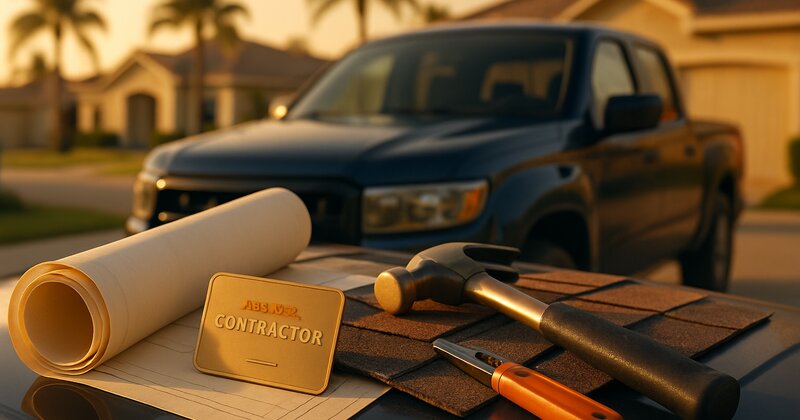
How a Port Charlotte roofer could lose a $28,000 re-roof because his website didn't show his license number
Here is a hypothetical scenario, a composite with illustrative numbers rather than a real case. Picture a Port Charlotte homeowner who needs a new roof. Hurricane Ian damage, insurance approved, check in hand. She searched "roofers Port Charlotte" on a Tuesday afternoon in March.
Three companies showed up in the Google map pack. All had good reviews (4.5+ stars). All claimed to be licensed and insured. All mentioned hurricane experience.
She clicked through to all three websites looking for one thing: proof of licensing.
Company #1 (the one who lost the job): Website said "Licensed and Insured" in the footer. No license number visible. No link to verify. She had to dig through the Contact page to find a phone number, call, and ask for the license number. Voicemail. She left a message. No callback for six hours.
Company #2: Website had a dedicated "Credentials" page. Florida license number displayed prominently at the top (CCC1234567). Text said "Verify our license at MyFloridaLicense.com." She clicked the link and saw the license was active and in good standing. She also saw their workers' comp exemption was current and their liability insurance was valid. Two minutes, no phone call needed.
Company #3: Website mentioned licensing but no number visible. She moved on.
She called Company #2 that afternoon. Estimate scheduled for Thursday. Contract signed the following Monday. $28,400 re-roof completed three weeks later.
Company #1 called her back that evening (six hours after her voicemail). She'd already scheduled with Company #2. "Thanks, but I've already moved forward with someone else."
The Company #1 owner was frustrated. "We're licensed. We're insured. We've been roofing in Port Charlotte for 12 years, way before Ian. Our prices beat most of the storm chasers. But we keep losing jobs to companies that just got here."
The issue wasn't price or experience. It was trust and friction.
Port Charlotte homeowners have been burned by unlicensed contractors and fly-by-night storm chasers since Hurricane Charley (2004), and insurance scammers piled on after Hurricane Ian (2022). They've learned to verify everything before they call.
If your license number isn't visible on your website, you've already lost to a competitor who shows theirs.
Why Port Charlotte is different from Sarasota or Bradenton (and why contractors need to adjust their online presence accordingly)
Port Charlotte is in Charlotte County, not Sarasota County or Manatee County. It's 30-40 minutes south of Venice. Population around 70,000 (pre-Ian), with significant growth post-Ian as people rebuild or relocate.
What makes Port Charlotte's contractor market unique:
1. Ongoing multi-year hurricane rebuilding cycle
Hurricane Charley hit Port Charlotte directly in 2004. Catastrophic damage. Rebuilding took years.
Hurricane Ian hit Port Charlotte (and neighboring Punta Gorda, Englewood, and North Port) in September 2022. Another direct hit. Catastrophic storm surge and wind damage across Charlotte County.
As of early 2025, Port Charlotte is still rebuilding. Roofs are still being replaced. Homes are still being repaired. Remodels are happening as homeowners take insurance payouts and upgrade while they rebuild.
What this means for contractors:
- High demand: Roofers, GCs, remodelers, and restoration contractors are booked weeks or months out
- High urgency: Homeowners need work done NOW (they're living in damaged homes or racing insurance deadlines; some are waiting to move back in)
- High stakes: Most jobs are insurance-funded ($15,000-50,000+ projects), which means homeowners are extra cautious about hiring the right contractor
The search behavior is different from a normal market. Homeowners aren't casually browsing. They're in crisis mode. They're searching multiple times per day. They're vetting contractors aggressively. They want proof of legitimacy before they call.
2. Storm chaser competition (out-of-town contractors flooding the market)
Every major hurricane brings a wave of out-of-state and out-of-town contractors who descend on the affected area, knock on doors, lowball estimates, take deposits, and sometimes disappear before finishing the job.
Port Charlotte homeowners know this pattern. They've seen it after Charley. They've seen it after Ian. They're skeptical of anyone they don't recognize.
The question every Port Charlotte homeowner is asking when they search for a contractor:
"Are you local, or are you a storm chaser?"
If your website doesn't answer that question immediately and clearly, you lose trust.
How to signal you're local (not a storm chaser):
Bad website homepage:
"Roofing contractor serving Florida. Licensed and insured. Quality work, fair prices. Call today!"
Why it's bad: Could be anyone. No location specificity. No proof of local presence. Sounds like a generic storm chaser template site.
Good website homepage:
"Port Charlotte Roofing - Serving Charlotte County Since 2012
Family-owned roofing contractor based in Port Charlotte. We've lived and worked here through Hurricane Charley (2004) and Hurricane Ian (2022). We're not storm chasers - we're your neighbors. Florida license CCC1234567 (verify at MyFloridaLicense.com). Fully insured with workers' comp and liability coverage. Locally owned, locally operated, here to stay."
Why it works:
- Mentions Port Charlotte twice in the first few sentences (local signal)
- Mentions Charlotte County (reinforces local presence)
- Mentions timeline (serving since 2012 - proves you were here before the storm)
- Explicitly addresses storm chaser concern ("We're not storm chasers - we're your neighbors")
- Shows license number up front (proof of legitimacy)
- Mentions both Charley and Ian (shows long-term local experience)
The pattern: Port Charlotte homeowners are hyper-aware of storm chasers. Your website needs to prove you're local, established, and legitimate within the first 10 seconds.
3. Insurance claim complexity (and why homeowners want contractors who understand the process)
Most post-Ian Port Charlotte roofing and remodeling jobs are insurance-funded. Homeowners filed claims, adjusters assessed damage, insurance companies issued settlements.
But insurance claims are complicated:
- Depreciation (actual cash value vs. replacement cost)
- Scope disputes (insurance says repair, homeowner wants replacement)
- Supplement requests (contractor finds additional damage during work, needs to file for more money)
- Code upgrades required by permit (new roof needs to meet current wind rating, insurance may not cover the full cost)
Homeowners want contractors who understand insurance claims and can help you through the process (without crossing the line into public adjuster territory, which requires a separate license in Florida).
How to signal insurance claim experience on your website:
Add an FAQ section (or dedicated page) about insurance claims:
"Do you work with insurance claims?
Yes. Most of our Port Charlotte roofing projects since Hurricane Ian have been insurance-funded. We understand the insurance claim process and we'll work with you and your adjuster to make sure the scope of work matches the damage.
What we provide for insurance claims:
- Detailed written estimate matching your adjuster's line items (makes it easy to compare our prices to your settlement)
- Photo documentation of all damage (helps support supplement requests if additional damage is found)
- Explanation of code upgrade requirements (Florida Building Code requires new roofs to meet current wind ratings - we'll explain what that means for your project and your insurance coverage)
- Coordination with your adjuster (we'll meet your adjuster on-site if needed, answer questions, and provide additional documentation)
What we DON'T do:
- We don't file claims on your behalf (that's your responsibility or your public adjuster's if you hired one)
- We don't negotiate with your insurance company (we're contractors, not public adjusters - negotiating claims without a public adjuster license is illegal in Florida)
- We don't guarantee your insurance will cover the full cost (every policy is different - we'll help you understand what's covered and what's not, but the final decision is between you and your insurer)
Our role: We provide accurate estimates, quality work, and clear communication so your insurance claim goes as smoothly as possible. We've helped 200+ Port Charlotte homeowners navigate insurance-funded roof replacements since Hurricane Ian."
Why this works:
- Shows you understand the insurance process (builds confidence)
- Explains what you DO and what you DON'T do (sets realistic expectations and shows you know the legal boundaries)
- Mentions specific post-Ian experience (200+ projects - proves depth of experience)
- Addresses common homeowner concerns (supplements, code upgrades, adjuster coordination)
We covered this in our guide on citations and online authority. For contractors in rebuilding markets, insurance claim mentions and FAQ content build trust faster than generic marketing copy.
4. Permit requirements and code enforcement (stricter post-Ian)
Charlotte County (and most Florida counties) tightened permit enforcement and code requirements after Hurricane Ian.
New roofs in Port Charlotte must:
- Meet current Florida Building Code wind ratings (typically 130-150 mph depending on location and proximity to coast)
- Pass multiple inspections (tear-off inspection, deck inspection, final inspection)
- Use approved materials and installation methods (certain shingle types, fastener spacing, underlayment requirements)
Homeowners know this. They've heard stories of contractors who skipped permits, failed inspections, or cut corners on code compliance.
If your website mentions permits and inspections explicitly, you signal professionalism and legitimacy.
Example website section:
"Permits and Inspections for Port Charlotte Roofs
Every roof replacement in Port Charlotte requires a permit from Charlotte County Building Department. We pull permits for every project - no exceptions.
Our permit process:
- We apply for the permit after contract signing (typically approved within 3-5 business days)
- We schedule the tear-off inspection (inspector verifies old roof is removed and deck is sound before we install new materials)
- We schedule the final inspection after installation (inspector verifies the roof meets Florida Building Code wind ratings, fastener spacing, and flashing requirements)
- We provide you with the final inspection approval and permit sign-off (you'll need this when you sell your home)
Permit cost: $250-450 depending on roof size (included in our quoted price - you don't pay separately)
Why permits matter: A permitted roof meets current code, passes inspections, and protects your home in the next hurricane. An unpermitted roof is illegal and may void your homeowner's insurance. It can also cause problems when you sell (title companies and buyers will ask for proof of permits). We never skip permits. If a contractor offers to 'save you money' by skipping the permit, walk away."
Why this works:
- Explains the permit process step-by-step (educates homeowners and shows you know the process)
- Mentions cost (homeowners want to know)
- Explains why permits matter (addresses the "why should I care" question)
- Warns against unpermitted work (positions you as the honest, professional choice)
The "verify my license" link strategy (and why it's the single highest-trust signal you can add to your website)
Here's the simplest, highest-ROI trust signal for Port Charlotte contractor websites:
Add your Florida license number and a direct link to verify it on MyFloridaLicense.com.
Example (in your website header, footer, or About page):
"Florida Licensed Roofing Contractor CCC1234567
Verify our license at MyFloridaLicense.com"
Why this works:
1. Homeowners can verify in 10 seconds (removes friction)
Without the link: Homeowner has to Google "Florida license lookup," find the MyFloridaLicense.com site, navigate to the search page, type in your company name or license number, and verify. That's 2-3 minutes and multiple steps. Most people don't bother.
With the link: Homeowner clicks. Sees your license is active, sees your insurance is current, sees your business address. 10 seconds. Easy verification.
The easier you make it to verify your credentials, the more likely homeowners are to trust you and call you.
2. It signals confidence and transparency
Contractors who hide their license number or make it hard to find look shady. Homeowners assume you're unlicensed or have complaints.
Contractors who display their license number prominently and link directly to the verification page signal: "We're legitimate. We have nothing to hide. Verify us yourself."
That confidence builds trust faster than any marketing copy.
3. It filters out price shoppers and attracts serious, qualified leads
Homeowners who verify your license before calling are serious. They're not just price shopping. They're vetting contractors carefully. They want quality and legitimacy.
Those are the leads you want (higher close rate, higher average project value, fewer headaches).
Homeowners who never check your license and just call the first number they see are often price shoppers or less informed (lower close rate, more likely to go with the cheapest bid regardless of quality).
By making verification easy, you attract better leads.
4. Google and AI see it as an authority signal
Google's algorithms (and AI tools like ChatGPT and Perplexity) look for trust signals when ranking local businesses or recommending contractors.
A license number with a verification link is a strong trust signal. It shows you're a legitimate, registered business with state oversight.
Over time, this helps your search rankings and your visibility in AI-generated recommendations.
We covered this in our post on which AI tools your customers are using. For contractors, license verification is one of the most powerful authority signals.
The Google Business Profile setup for Port Charlotte contractors (the technical checklist most get wrong)
Most Port Charlotte contractor GBPs are incomplete or outdated. Here's the checklist:
1. Service area settings (be specific about Charlotte County coverage)
GBP > Info > Service Area > Edit
Add Port Charlotte AND surrounding Charlotte County areas:
- Port Charlotte, FL
- Punta Gorda, FL
- North Port, FL (southern part, overlaps with Charlotte and Sarasota counties)
- Englewood, FL (Charlotte County portion)
- Charlotte County, FL
Also add nearby areas you serve:
- Venice, FL (northern Sarasota County, 20 minutes north)
- Rotonda West, FL
- Deep Creek, FL
- Charlotte Harbor, FL
Why this matters: Someone in Punta Gorda searching "roofers near me" needs to see you in results. If you only list "Port Charlotte," Google may not show you for Punta Gorda searches (even though it's 10 minutes away).
2. Business description (use all 750 characters and mention Ian experience)
Weak description:
"Roofing contractor in Port Charlotte. Licensed and insured. Quality work, fair prices."
Strong description:
"Family-owned roofing contractor serving Port Charlotte, Punta Gorda, and Charlotte County since 2012. We've been here through Hurricane Charley and Hurricane Ian - we're not storm chasers, we're your neighbors. Florida licensed (CCC1234567), fully insured with workers' comp and liability coverage. We specialize in insurance claim roofs and hurricane damage repair, plus full re-roofs for Port Charlotte homes. We pull permits for every job and coordinate with adjusters. Every job gets a written warranty. Most Port Charlotte re-roofs completed in 2-4 days. Emergency tarping available 24/7. Locally owned, locally operated, here to stay. Verify our license at MyFloridaLicense.com."
Why the strong version works:
- Mentions "Port Charlotte" 4 times (strong relevance signal)
- Mentions Charlotte County and surrounding areas (Punta Gorda)
- Mentions timeline (since 2012 - proves you were here before Ian)
- Addresses storm chaser concern explicitly
- Shows license number (trust signal)
- Mentions insurance claim experience (relevant to most post-Ian jobs)
- Mentions permit compliance (professionalism signal)
- Mentions emergency services (meets urgent need)
3. Primary and secondary categories
Pick the narrowest category that fits your work.
If you're a roofer:
- Primary category: "Roofing contractor"
- Secondary categories: "Roof repair service," "Metal roofing contractor" (if applicable)
If you're a general contractor:
- Primary category: "General contractor"
- Secondary categories: "Remodeler," "Home builder," "Construction company"
Why this matters: Google uses categories to filter search results. If you only select "Contractor" (generic), you won't show up for "roofers Port Charlotte" searches.
4. Posts mentioning Hurricane Ian recovery and insurance claims
Post 2-3 times per week. Rotate between project updates, insurance claim tips, and emergency services.
Week 1 post example:
"Completed another Hurricane Ian insurance claim roof in Port Charlotte this week. Full tear-off and re-roof with architectural shingles, upgraded to meet current Florida Building Code wind ratings. Permitted and inspected by Charlotte County. If you're still waiting on your roof replacement, call us today. We're licensed, insured, and local - not storm chasers. Free estimates for Port Charlotte and Punta Gorda homeowners."
Week 2 post example:
"Insurance claim tip for Port Charlotte homeowners: If your adjuster's estimate seems low, you can request a supplement. We'll inspect your roof and document any damage the adjuster missed. Then we help you file for the additional funds you're owed. We've helped 200+ Port Charlotte homeowners get fair insurance settlements since Hurricane Ian. Call for a free inspection and estimate."
Week 3 post example:
"Emergency roof tarping available 24/7 for Port Charlotte and Charlotte County. If your roof is leaking or damaged, don't wait - call us now. We'll tarp it today to prevent further damage, then provide a written estimate for permanent repair or replacement. Licensed Florida roofing contractor CCC1234567. Serving Port Charlotte since 2012."
The pattern: Every post mentions Port Charlotte or Charlotte County and addresses insurance claims or hurricane damage (relevant to current demand). Each one also reinforces your local presence and licensing.
5. Photos showing Port Charlotte projects (with location context)
Upload photos with captions like:
- "Roof replacement in progress - Port Charlotte, FL (Hurricane Ian insurance claim)"
- "Completed re-roof in Punta Gorda - architectural shingles, permitted and inspected"
- "Our Port Charlotte crew installing new roof - licensed and insured, local team"
Why this works: Photos with location-specific captions reinforce to Google that you actively work in Port Charlotte and Charlotte County.
Also upload photos of:
- Your crew with your truck (shows you have local equipment and team, not just a phone number)
- Permit documents or inspection approvals (shows you pull permits and pass inspections)
- Before/after shots of hurricane damage repairs (shows your capability and experience)
We covered photos and local SEO in detail. For contractors in rebuilding markets, project photos with location tags and damage context are critical trust signals.
The "we've been here since before the storm" timeline strategy (how to prove you're not a storm chaser)
The single most important trust signal for Port Charlotte contractors is proving you were established BEFORE Hurricane Ian (September 2022).
Storm chasers arrived after Ian. Local contractors were here before.
How to prove your timeline on your website:
Strategy 1: Add a timeline or "Our Story" section
Example:
"Our Port Charlotte Story
2012: Started our roofing business in Port Charlotte. We're a local family - born and raised in Charlotte County.
2004: Survived Hurricane Charley. Spent the next three years helping our neighbors rebuild. Learned firsthand what Port Charlotte homeowners need in a roofing contractor after a catastrophic storm.
2012-2021: Built our reputation one roof at a time. Hundreds of Port Charlotte and Punta Gorda homes re-roofed, repaired, and maintained.
2022: Hurricane Ian hit. Our own homes and business were damaged. But we stayed, rebuilt, and helped our community recover. We've completed 200+ insurance claim roofs since Ian.
2025: Still here. Still local. Still roofing Port Charlotte homes with the same quality and integrity we've always had. We're not going anywhere - this is our home too."
Why this works:
- Specific years and events (proves timeline)
- Mentions both Charley and Ian (shows long-term local presence)
- Acknowledges your own storm damage (builds empathy and trust - you're not an outsider, you're a neighbor who went through the same thing)
- Ends with commitment to stay (addresses storm chaser concern)
Strategy 2: Show project history and reviews from before Ian
Add a "Portfolio" or "Recent Projects" page with timestamps.
Example:
"Port Charlotte Roofing Projects
2024: 87 roofs completed (mostly Hurricane Ian insurance claims)
2023: 92 roofs completed (Ian recovery continues)
2022: 45 roofs completed (pre-Ian + immediate post-Ian emergency tarping and repairs)
2021: 38 roofs completed
2020: 41 roofs completed
2019: 36 roofs completed
See our portfolio of completed Port Charlotte projects ([link]) with before/after photos and homeowner testimonials."
Why this works: Shows continuous activity before and after Ian. Storm chasers can't show project history from 2019-2021 because they weren't here.
Strategy 3: Collect and display reviews from before Ian
Check your Google reviews. Do you have reviews from 2021, 2020, 2019?
If yes, highlight them on your website.
Example website section:
"Don't Take Our Word - Here's What Port Charlotte Homeowners Said BEFORE Hurricane Ian"
[Pull 3-5 Google reviews from 2019-2021 and display them on your website with dates visible]
Why this works: Proves you had satisfied customers before the storm. Storm chasers can't show pre-2022 reviews because they didn't exist yet.
The insurance claim FAQ content strategy (answer the questions homeowners are Googling)
Port Charlotte homeowners searching for contractors are also searching for insurance claim information. If your website answers those questions, you become the trusted authority.
High-volume insurance claim searches in Port Charlotte (post-Ian):
- "How much does insurance pay for roof replacement Florida"
- "What if my insurance estimate is too low"
- "Do I have to use the contractor my insurance recommends"
- "How long do I have to file a hurricane claim in Florida"
- "What is ACV vs RCV for roof insurance"
Add these questions (and detailed answers) to your FAQ page:
FAQ #1: How much does insurance pay for roof replacement in Florida?
"Insurance payouts for roof replacement in Florida vary based on your policy, your deductible, and the age of your roof.
Typical payout structure:
- Actual Cash Value (ACV): Insurance pays the depreciated value of your roof upfront (e.g., if your roof was 15 years old, they deduct depreciation and pay maybe 50-70% of replacement cost)
- Replacement Cost Value (RCV): After the roof is installed and you submit proof of completion, insurance pays the remaining depreciation (the other 30-50%)
Example for a Port Charlotte home:
- Full roof replacement cost: $18,000
- Roof age: 12 years old
- Depreciation: $6,500
- Insurance pays ACV upfront: $11,500 ($18,000 - $6,500)
- You pay your deductible: $2,500 (typical deductible)
- Out-of-pocket after ACV: $2,500 deductible + $6,500 depreciation held back = $9,000
- After roof is installed, you submit completion paperwork to insurance
- Insurance releases RCV (depreciation): $6,500
- Your final out-of-pocket: $2,500 (just your deductible)
What this means: You'll need to cover your deductible + depreciation upfront, then get the depreciation back after completion.
We'll help: We provide all the documentation you need to submit for RCV recovery (final bill, photos, permit sign-off, lien waiver). We've helped 200+ Port Charlotte homeowners recover their full RCV since Hurricane Ian."
Why this works:
- Explains a complex topic (ACV vs RCV) in plain language
- Uses a realistic Port Charlotte example with real numbers
- Shows you understand the process (builds trust)
- Explains your role (we provide documentation to help you recover RCV)
FAQ #2: What if my insurance estimate is too low?
"If your insurance adjuster's estimate seems too low, you have options.
Common reasons estimates are low:
- Adjuster missed damage (didn't see all the shingle damage, underlayment damage, or deck damage)
- Adjuster used low prices (insurance cost databases sometimes undervalue actual contractor costs in high-demand markets like post-Ian Port Charlotte)
- Adjuster classified damage as 'repair' when it should be 'replacement' (Florida code often requires full replacement even if only part of the roof is damaged)
Your options:
- Request a re-inspection: Call your insurance company and ask for a second inspection. Explain what the adjuster missed.
- File a supplement request: Hire a contractor (like us) to inspect and document additional damage. We'll provide a detailed estimate. You submit it to your insurance company as a supplement request.
- Hire a public adjuster: Public adjusters negotiate with your insurance company on your behalf (they typically charge 10-20% of the final settlement). Only needed for complex disputes.
- File a complaint with Florida Department of Financial Services: If your insurance company is acting in bad faith (denying legitimate claims, lowballing payouts, delaying unreasonably), you can file a complaint with the state.
Our role: We'll provide a free inspection and detailed estimate. If our estimate is significantly higher than your adjuster's, we'll document the differences and provide you with the paperwork to submit a supplement request. We've helped 200+ Port Charlotte homeowners get fair settlements since Hurricane Ian.
We do NOT: Act as public adjusters (that requires a separate Florida license) or negotiate directly with your insurance company (that's your responsibility or your public adjuster's). We provide contractor expertise and documentation to support YOUR claim."
Why this works:
- Acknowledges a common frustration (low estimates)
- Explains multiple options (empowers homeowner)
- Clarifies your role (helpful without overstepping legal boundaries)
- Mentions specific experience (200+ homeowners helped)
FAQ #3: Do I have to use the contractor my insurance recommends?
"No. You have the right to choose your own contractor in Florida.
Insurance companies sometimes provide a 'preferred contractor' list. These are contractors the insurance company has a relationship with. You are NOT required to use them.
You can:
- Get estimates from multiple contractors (including insurance-preferred contractors and independent contractors like us)
- Choose the contractor you trust most (based on reviews, licensing, experience, and your own research)
- Hire any licensed Florida contractor regardless of whether they're on your insurance company's list
Why some insurance companies push preferred contractors:
- They've negotiated rates (often lower than market rate)
- They have a business relationship (the contractor may be more willing to work within the insurance estimate without filing supplements)
Why you might choose an independent contractor:
- We work for YOU, not your insurance company
- We'll document all damage accurately and file supplements if needed (we're not incentivized to minimize scope like some insurance-preferred contractors)
- We're local, established Port Charlotte contractors (not national networks with rotating subcontractors)
Bottom line: It's your home, your claim, and your choice. Choose the contractor you trust most. We're happy to compete on quality, experience, and price - not on who has a business relationship with your insurance company."
Why this works:
- Answers a common question directly (no, you don't have to use their contractor)
- Explains the dynamics (why insurance companies push preferred contractors)
- Positions you as the homeowner advocate (we work for you, not the insurance company)
- Ends with confidence (we're happy to compete on merit)
Add 5-7 insurance claim FAQs to your website. These questions get searched constantly by Port Charlotte homeowners. If your website answers them well, you become the trusted resource (and the contractor they call).
The emergency services positioning (and why "24/7 tarping" is a high-value keyword)
Port Charlotte homeowners dealing with storm damage or roof leaks often search:
- "Emergency roof repair Port Charlotte"
- "Roof tarping Port Charlotte"
- "24/7 roofer Charlotte County"
- "Roof leak repair near me"
These are high-intent, high-urgency searches. Someone searching at 9pm on a Saturday has a leaking roof and needs help NOW.
If you offer emergency tarping or leak repair, make it visible on your website and GBP.
Website homepage section example:
"24/7 Emergency Roof Tarping for Port Charlotte and Charlotte County
Roof leaking? Shingles blown off? Don't wait - call us now.
Our emergency services:
- Emergency tarping (temporary weatherproof cover until permanent repair or replacement)
- Leak detection and temporary sealing
- Storm damage assessment (we'll document damage for your insurance claim)
Response time: We dispatch within 2 hours for Port Charlotte and Punta Gorda emergencies (24/7, including nights, weekends, and holidays).
Cost: Emergency tarping starts at $400-800 depending on roof size and damage severity. You get a written estimate before we start.
What happens next: After we tarp your roof and stop the leak, we'll provide a full written estimate for permanent repair or replacement. If you're filing an insurance claim, we'll document everything you need.
Call now: (941) 555-1234 - 24/7 emergency line
Licensed Florida roofing contractor CCC1234567. Serving Port Charlotte since 2012."
Why this works:
- Clear headline (24/7 Emergency Roof Tarping)
- Lists specific services (tarping, leak repair, damage assessment)
- Mentions response time (2 hours - sets expectations)
- Mentions cost range (transparency builds trust)
- Explains next steps (tarping is temporary, we'll provide estimate for permanent fix)
- Includes dedicated phone number for emergencies
- Reinforces licensing and local presence
Google Business Profile post example:
"EMERGENCY ROOF TARPING AVAILABLE NOW
Roof leaking after last night's storm? We're dispatching emergency tarping crews across Port Charlotte and Charlotte County today. Call (941) 555-1234 now - 24/7 emergency line. We'll tarp your roof within 2 hours to prevent further water damage, then provide a written estimate for permanent repair or replacement. Licensed and insured Florida roofing contractor. Don't wait - every hour of delay means more interior damage."
Why this works:
- Urgent tone (matches the searcher's urgency)
- Specific timeframe (within 2 hours)
- Clear call to action (call now, here's the number)
- Mentions consequence of delay (more interior damage - creates urgency)
Emergency services capture high-value leads (customers who need help immediately and are less price-sensitive because urgency outweighs cost). Make sure your website and GBP clearly advertise 24/7 availability if you offer it.
The out-of-town contractor filter (and how to position against storm chasers without sounding defensive)
Port Charlotte homeowners are tired of storm chasers. But you can't just say "we're not storm chasers" without sounding defensive.
Better approach: Prove local presence through specific details.
Strategy 1: Mention local landmarks and neighborhoods by name
Generic: "We serve Port Charlotte and surrounding areas."
Specific: "We serve Port Charlotte neighborhoods including Port Charlotte Town Center, Burnt Store Meadows, Deep Creek, Suncoast Estates, and El Jobean. We also serve Punta Gorda, Rotonda West, and Englewood. If you're in Charlotte County, we're your local roofer."
Why this works: Storm chasers don't know Port Charlotte neighborhoods. Mentioning them by name signals deep local knowledge.
Strategy 2: Reference local landmarks, roads, and geography
Example website paragraph:
"Our shop is on Tamiami Trail in Port Charlotte, just south of the Port Charlotte Town Center. We've been in this location since 2012. If you're near Burnt Store Road, Midway Boulevard, or Kings Highway, we're 10-15 minutes away. We know Port Charlotte streets and Charlotte County permitting. We also know how hurricane damage affects homes in this area (we rebuilt our own after Ian)."
Why this works:
- Mentions specific roads (Tamiami Trail, Burnt Store Road, Midway, Kings Highway)
- Mentions local landmarks (Port Charlotte Town Center)
- Mentions physical shop location (proves you have a real local presence, not just a phone number)
- Mentions post-Ian personal experience (builds empathy and credibility)
Strategy 3: Show your team and local ties
Add a "Meet Our Team" or "About Us" page with photos and bios.
Example bio:
"Mike Rodriguez - Owner and Lead Estimator
Port Charlotte native. Graduated from Charlotte High School in 2005. Started in roofing right after Hurricane Charley (2004) helping my uncle's crew rebuild Port Charlotte homes. Got my Florida roofing license in 2012 and started (Company Name). Married with two kids. We live in Port Charlotte and we're raising our family here. This isn't just business - it's our community."
Why this works:
- Local credibility (born and raised in Port Charlotte, went to local high school)
- Long-term presence (started in roofing in 2004, licensed in 2012)
- Personal stake (raising a family here - signals commitment to stay)
Storm chasers can't tell these stories because they're not from here.
Strategy 4: Show Google reviews from local customers (with neighborhood mentions)
Encourage customers to mention their neighborhood in reviews (similar to the Palmer Ranch strategy from the voice samples).
Example request (after completing a job):
"Thanks for trusting us with your Port Charlotte home! If you're willing to leave a Google review, feel free to mention you're in [Burnt Store Meadows/Deep Creek/Suncoast Estates] - it helps other neighbors in your area know we serve the community. Want me to text you the review link right now?"
Over time, you build a review profile like:
- "Best roofer in Port Charlotte. We're in Burnt Store Meadows and they completed our Ian claim roof in three days. Licensed, insured, and local - not storm chasers." - Port Charlotte resident
- "Highly recommend for Deep Creek homeowners. They know Charlotte County permitting and they pulled our permit same-week." - Port Charlotte resident
- "We're in Suncoast Estates and (Company Name) has been our go-to roofer for years, even before Hurricane Ian." - Port Charlotte resident
Google sees this review diversity and thinks: "This business serves multiple Port Charlotte neighborhoods - strong local presence."
Homeowners see reviews from their specific neighborhood and think: "They've worked in my area before - they're local."
The permit and code compliance content (technical but necessary for trust)
Most Port Charlotte homeowners don't understand Florida Building Code or Charlotte County permit requirements. But they know permits matter (especially post-Ian).
If you explain permits and code compliance clearly on your website, you position yourself as the professional, knowledgeable contractor (versus the storm chaser who offers to "save you money" by skipping permits).
Add a dedicated "Permits and Code Compliance" page or FAQ section.
Example content:
"Charlotte County Roofing Permits: What You Need to Know
Do I need a permit for roof replacement in Port Charlotte?
Yes. All roof replacements in Charlotte County require a permit from the Charlotte County Building Department. Repairs covering more than 25% of the roof also require a permit.
What does the permit process involve?
- Application: We submit permit application with your project details (roof size, materials, installation method)
- Approval: Charlotte County reviews and approves (typically 3-5 business days)
- Tear-off inspection: Inspector visits after we remove old roof to verify roof deck is sound
- Final inspection: Inspector visits after installation to verify the roof meets Florida Building Code requirements (wind rating, fastener spacing, flashing, underlayment)
- Certificate of completion: County issues permit sign-off (you'll need this when you sell your home)
Permit cost: $250-450 depending on roof size (included in our quoted price)
What code requirements apply to Port Charlotte roofs?
- Wind rating: New roofs must meet current Florida Building Code wind ratings (typically 130-150 mph depending on your location and proximity to the coast)
- Fastener spacing: Shingles must be fastened according to manufacturer specs and code (typically 6 nails per shingle in high-wind zones)
- Underlayment: Synthetic underlayment required in most cases (better wind and water resistance than old felt paper)
- Flashing: Proper flashing around chimneys, vents, and roof valleys (prevents leaks)
Why permits matter:
- Insurance: Unpermitted roofs may void your homeowner's insurance (insurers can deny claims if work wasn't permitted)
- Resale: When you sell your home, buyers and title companies will ask for proof of permits for any major work (unpermitted roofs can kill a sale or force you to discount)
- Safety: Permitted roofs are inspected and verified to meet code (unpermitted roofs may have shortcuts that fail in the next hurricane)
We pull permits for every Port Charlotte roof - no exceptions. If a contractor offers to skip the permit to save money, walk away. The savings aren't worth the risk."
Why this works:
- Explains the permit process step-by-step (educates homeowners)
- Lists specific code requirements (shows technical knowledge)
- Explains why permits matter (addresses the "why should I care" question)
- Warns against unpermitted work (positions you as the honest, professional choice)
- Ends with firm commitment (we pull permits, no exceptions)
What to do this week (5 steps to capture Port Charlotte's rebuilding demand)
Monday: Add your Florida license number to your website homepage, header, or footer. Then add a direct link to verify it on MyFloridaLicense.com. Example: "Florida Licensed Roofing Contractor CCC1234567 - Verify our license here". This takes 10 minutes and is the single highest-trust signal you can add.
Tuesday: Open your Google Business Profile and update your business description. Make sure it mentions Port Charlotte (or your primary city) and your license number. Add how long you've been in business and your Hurricane Ian experience. Use all 750 characters. Use the stronger description examples from earlier in this post as a model.
Wednesday: Check your Google Business Profile service area settings. Does it include Port Charlotte, Punta Gorda, North Port, Englewood, and other Charlotte County areas you serve? If not, add them today. Then check your categories - make sure your primary category is specific (e.g., "Roofing contractor" not just "Contractor").
Thursday: Write your first insurance claim FAQ. Pick one question from the list earlier in this post, such as "How much does insurance pay for roof replacement in Florida?" or "What if my insurance estimate is too low?" Write a 300-400 word answer with specific details and Port Charlotte context. Post it on your FAQ page, and if your site has no FAQ page yet, this answer is a good first entry.
Friday: Take 5-10 photos today of your current or recent Port Charlotte projects. Photograph your crew working, your truck with your company name visible, before/after shots of roofs, and permit documents or inspection approvals (if you have permission from the homeowner). This weekend, upload 2-3 photos to your Google Business Profile with captions like "Roof replacement in progress - Port Charlotte, FL (Hurricane Ian insurance claim)."
That's your starting point. Most Port Charlotte contractors have incomplete GBPs and no license verification on their websites. Few have any insurance claim content. If you complete these five tasks this week, you'll outrank 80% of your local competition (and filter out the storm chasers who can't match your local credibility).
If you want a simple website that puts the basics in front of Port Charlotte homeowners, Suncoast Local (a division of Postcard Advantage LLC) builds one. It is six pages: home, about, services, areas served, questions and contact, plus the legal pages. We write it from what you tell us on one order form, so your license number, the neighborhoods you work in and your answers to common insurance questions can all be on it. We never add a license, review or award you didn't tell us about.
The price is $499 a year with everything included (writing, your own domain with a hello@ address forwarded to your email, hosting, security certificate, backups and a login to change anything yourself). No setup fee, no monthly bill, and it is live 24 to 48 hours after payment. Start your contractor website, look at what's included, or call (888) 348-1992 to ask a question first.
A Port Charlotte homeowner just got her insurance settlement check for a $22,000 roof replacement. She searched "licensed roofers Port Charlotte" and opened three contractor websites. Your website says "Licensed and Insured" in the footer but doesn't show your license number. Competitor #1 shows their Florida license number with a direct verification link in the header. Competitor #2 has an FAQ page explaining insurance claims, permit requirements, and code compliance. She called both competitors for estimates. She never called you because she couldn't verify your license in 10 seconds and your website didn't answer any of her insurance questions. You lost a $22,000 job because you hid your credentials and assumed "licensed and insured" was enough. It's not. Not in a market where homeowners have been burned by storm chasers and are verifying everything before they call.
Port Charlotte's rebuilding boom means high demand and high urgency. Homeowners need roofers, GCs, and remodelers now. But they're vetting every contractor carefully because they've seen storm chasers take deposits and disappear. Show your license number, explain the insurance claim process, prove you were here before Ian, and mention Port Charlotte neighborhoods by name - or keep losing jobs to contractors who figured out that transparency beats marketing copy every time in a rebuilding market.
Keep reading
When 'Sarasota wedding photographer' searches pull up Tampa results - fixing the radius problem
A Sarasota wedding photographer can watch ideal couples hire Tampa competitors because Google's geographic logic fails small markets. Here's how schema markup and hyper-local content fix the radius problem.

Charlotte County recovery searches: storm-proofing your business's online presence after Ian
After a hurricane, buyers verify you're open, insured, and local before spending. Here's how Charlotte County businesses storm-proof their online presence so recovery customers find you first.
Winning the 41 corridor: how Bayshore Gardens businesses compete next to the big boxes
The US 41 corridor through Bayshore Gardens is packed with national chains. Local businesses win with Spanish-language reach, genuine reviews, neighborhood loyalty, and showing up for specific service searches the big boxes ignore.