
Local SEO · July 13, 2026 · 24 min read
Siesta Key businesses: how to show up when 350,000 monthly visitors search 'near me'
350,000 tourists visit Siesta Key every month and almost none of them know your business name. They search "breakfast near me" and "best beach bar Siesta Key." If proximity, reviews, and photos don't win, you're invisible.
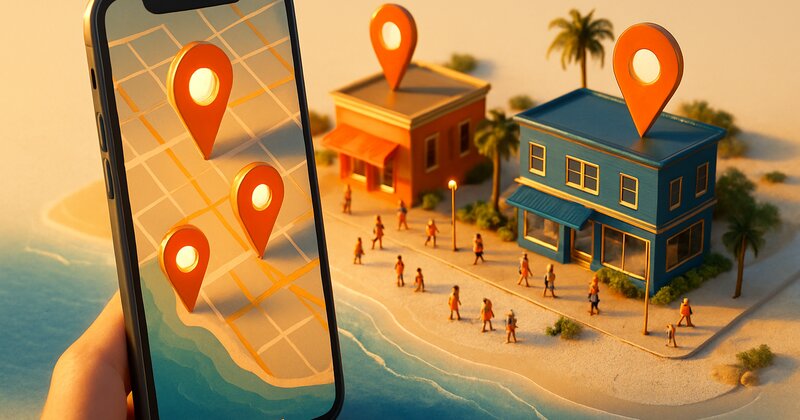
The rental guest who walked past your restaurant three times
It's 9 a.m. on a Saturday in February. A family from Ohio just checked into their Siesta Key vacation rental on Midnight Pass Road. They're hungry. Nobody knows where to eat.
The dad pulls out his phone and types "breakfast near me." Google shows him a map with three pins. He taps the first one, checks the photos, reads two reviews, and says "This one looks good. It's half a mile away."
They walk past your restaurant to get there.
Here's what happened: Your restaurant is two blocks from their rental. The place they chose is half a mile away. You have better food, better reviews, and you've been serving Siesta Key for 15 years.
But your Google Business Profile has 12 photos (all from 2019), 40 reviews (last one posted three months ago), and your hours say you close at 2 p.m. when you actually stay open until 3 p.m. on weekends.
The restaurant they picked has 140 photos (added weekly), 180 reviews (15 from the last 30 days), and a pin that shows up bigger and bolder on the map because Google's algorithm decided it was more relevant.
Proximity didn't save you. Reviews didn't save you. You lost the breakfast customer to a competitor who understands how tourists search.
This happens 10,000 times per day on Siesta Key. Vacation rental guests, snowbirds, day-trippers from Sarasota and Bradenton. Almost none of them know your business by name. They search generically: "best lunch Siesta Key," "beach bar near me," "ice cream," "bike rental," "pizza delivery 34242."
If your Google Business Profile isn't optimized for how tourists search, you're leaving money on the table every single day - and your competitors are picking it up.
Why Siesta Key search behavior is different from mainland Sarasota
A Sarasota local searching for a plumber knows what they're looking for. They might search "plumber Sarasota" or "Joe's Plumbing Sarasota" because they saw a truck or got a referral.
A Siesta Key tourist has zero context. They don't know neighborhood names. They don't know business names. They don't have referrals. They have a rental address, a Google Maps pin, and a 4-7 day window to eat, drink, shop, and book activities.
Here's how they search:
-
"Near me" searches: "Coffee near me," "breakfast near me," "beach bar near me." They're standing somewhere on the island and they want something within walking or short driving distance.
-
Generic category + Siesta Key: "Best seafood Siesta Key," "best breakfast Siesta Key," "happy hour Siesta Key." They're not downtown yet. They're planning from the rental.
-
Activity + location: "Kayak rental Siesta Key," "beach chair rental," "bike rental," "sunset cruise." They want to do something and they're Googling options.
-
Delivery searches: "Pizza delivery 34242," "Chinese food delivery near me." It's 8 p.m., they don't want to leave the rental.
What they're NOT searching: Your business name. "That place my friend told me about." Specific addresses.
The implication: If you're relying on brand recognition or repeat customers, you're missing 90% of the tourist market. You need to rank for generic, high-intent searches - and those rankings are decided by proximity, reviews, photos, and Google Business Profile activity.
The three ranking factors that matter most for Siesta Key "near me" searches
Google's local search algorithm weighs dozens of signals, but for tourist-driven "near me" searches on Siesta Key, three factors dominate:
1. Proximity (but it's not just physical distance)
Yes, Google prioritizes businesses close to the searcher. But "close" is more complicated than you think.
Google's proximity calculation includes:
-
Physical distance - If the searcher is standing on Beach Road and you're on Beach Road, you're closer than a business on Midnight Pass.
-
Service area or location setting - If your GBP lists a service area instead of a physical storefront, Google may rank you lower for hyperlocal "near me" searches.
-
Geo-relevance signals - If your GBP description, website, and reviews all mention "Siesta Key" explicitly, Google connects you more strongly to Siesta Key searches (even if you're technically in Sarasota proper).
-
Cluster density - If there are 12 restaurants on Ocean Boulevard and you're one of them, Google shows all 12 in the map view and lets the user filter by reviews, photos, and open hours. Proximity alone doesn't win.
The mistake most Siesta Key businesses make: They assume proximity is automatic. "I'm ON Siesta Key, of course I'll show up for Siesta Key searches."
Not true. If your GBP doesn't explicitly say "Siesta Key" in your description, address, or service area - and your reviews and website don't mention it - Google may decide you're less relevant than a competitor whose signals are clearer.
The fix: Make sure your GBP address says "Siesta Key, FL" (not just "Sarasota, FL"). Mention "Siesta Key" in your business description. Encourage customers to mention "Siesta Key" in reviews. Add "Siesta Key" to your website service pages and location content.
2. Review count, recency, and content quality
Tourists trust reviews more than locals do. A Sarasota resident might try your restaurant based on a friend's recommendation or because they drove past it for 10 years. A tourist from Michigan has zero context. They read reviews, look at star ratings, and make a decision in 60 seconds.
What Google's algorithm prioritizes:
-
Review count - Businesses with 100+ reviews rank higher than businesses with 30 reviews, all else equal.
-
Average rating - 4.5+ stars is the threshold. Anything below 4.3 and you're losing clicks to competitors.
-
Recency - Google favors businesses with reviews from the last 30-90 days. If your last review is six months old, you look dormant.
-
Review content - Reviews that mention specific menu items, services, experiences, or location details give Google more context. "Great fish tacos at the Siesta Key location, outdoor seating was perfect" is more valuable than "Good food!"
The tourist review behavior pattern:
Tourists review more frequently than locals. They're on vacation, they have time, they want to document their trip. If you serve 1,000 tourist customers per month and you're only getting 5-10 reviews, you're leaving ranking power on the table.
The fix: Ask for reviews at the point of peak satisfaction. The end of a great meal. The moment they return their rental bikes and say "That was awesome." The checkout email from your online booking system.
Make it easy. Send a direct Google review link via text or email. Don't ask them to "find us on Google" - that adds friction and cuts your review rate in half.
We wrote a detailed guide on how to ask for Google reviews without being annoying - it includes scripts, timing strategies, and how to stay within Google's review policy.
3. Photos (quantity, quality, and recency)
Tourists make decisions visually. They're scrolling through Google Maps on their phone, looking at 5-10 businesses in 30 seconds. The ones with great photos get clicked. The ones with 8 blurry exterior shots from 2017 get skipped.
What Google prioritizes:
-
Photo count - 50+ photos is the baseline for competitive tourist markets. 100+ is better. 200+ and you're in the top tier.
-
Photo recency - Google favors businesses that add photos regularly. If your most recent photo is from 2022, you're being outranked by competitors who add photos weekly.
-
Photo diversity - Exterior, interior, food, drinks, menu, team, views, customers (with permission). The more variety, the better.
-
Customer-uploaded photos - Photos from customers (not just the business owner) signal authenticity. Encourage customers to tag your business in their vacation photos.
The Siesta Key photo advantage:
You're on a beach. You have sunsets. You have outdoor seating with Gulf views. You have tourists taking photos constantly.
Use that. Post a sunset photo from your deck every week. Post a photo of your weekend special. Post a photo of your team setting up for the day. Encourage customers to tag you in their Instagram posts and offer to repost them (with credit) on your GBP.
The businesses dominating "near me" searches on Siesta Key have 150+ photos and add 3-5 new ones per week. That's the standard. If you're posting one photo per month, you're losing.
Check out our post on photos and local SEO ranking for the full breakdown of how photo volume and recency affect map pack rankings.
The vacation rental guest playbook (and how to intercept it)
Let's walk through the actual search behavior of a typical Siesta Key vacation rental guest.
Day 1 (before they arrive):
- Googles "best restaurants Siesta Key" from home in Ohio
- Reads a 2023 blog post on Visit Sarasota listing 8 restaurants
- Saves 3-4 restaurants in Google Maps
- Googles "things to do Siesta Key"
- Reads TripAdvisor and blogs, saves a few activities
Day 2 (first morning on the island):
- Wakes up, needs coffee
- Opens Google Maps, types "coffee near me"
- Picks the closest one with 4.5+ stars and good photos
- Walks there
Day 2-7 (throughout the week):
- Repeats "near me" searches for every meal and activity: "lunch near me," "ice cream near me," "beach bar near me," "bike rental near me"
- Occasionally searches "best [category] Siesta Key" when planning ahead
- Relies heavily on Google Maps, photos, and reviews
- Almost never remembers business names (asks "What was that place we went to Tuesday?")
Day 8 (after they leave):
- Writes 2-5 Google reviews for their favorite places
- Posts vacation photos on Instagram, tags a few businesses
Where you can intercept this playbook:
1. Pre-arrival searches (SEO and content)
If you have a blog, resource page, or service page that ranks for "best [category] Siesta Key," you can get on their radar before they arrive.
Example: A kayak rental company publishes a blog post: "Where to kayak on Siesta Key: 5 routes for beginners, families, and wildlife spotting." That post ranks on Google. Tourists find it while planning their trip. The post ends with "Rent kayaks from us - we're on Stickney Point Road, easy launch access to all five routes."
You just intercepted pre-arrival planning and positioned yourself as the local expert.
2. Day-of "near me" searches (GBP optimization)
This is the biggest volume and the highest intent. They're on the island, they're hungry or bored, they're searching right now.
Your GBP needs to win on:
- Proximity (you can't control this, but make sure your address is accurate and includes "Siesta Key")
- Rating (4.5+ stars minimum)
- Photos (50+ minimum, added regularly)
- Hours (accurate and updated for holidays/seasonality)
- Response time (if they message you via GBP, respond within an hour)
If you nail those five, you'll show up in the top 3 map results for most category searches on the island.
3. Post-visit reviews (timing and follow-up)
The best time to ask for a review is immediately after the experience while they're still on vacation and the satisfaction is fresh.
What works:
-
In-person ask: "If you have a moment to leave us a Google review, it really helps our small business - here's the link." (Hand them a card with a QR code or short URL.)
-
Receipt or check ask: "Thanks for dining with us! Scan here to leave a review." (QR code on the receipt.)
-
Follow-up text: "Hi [name], thanks for renting bikes from us today! If you have a sec, we'd love a Google review: [link]. Enjoy the rest of your trip!" (Send 2-4 hours after they return the bikes.)
Tourists are more likely to review during their vacation than after they get home and return to work. Strike while the iron is hot.
Real example: Two Siesta Key restaurants, same block, wildly different visibility
Let's compare two real restaurants on Siesta Key (names changed).
Restaurant A (strong "near me" visibility):
- Address: 5124 Ocean Blvd, Siesta Key, FL 34242
- GBP description: "Waterfront seafood restaurant on Siesta Key since 2005. Outdoor deck with Gulf views, fresh grouper, stone crab, daily happy hour 3-6 p.m. Walk from Siesta Beach. Live music Thursdays and Sundays."
- Reviews: 340 Google reviews, 4.7 stars, 22 reviews in the last 30 days
- Photos: 280 photos (owner-uploaded and customer-uploaded), most recent photo from 3 days ago
- Posts: Weekly GBP posts ("Tonight's special: blackened mahi tacos, $14. Happy hour starts at 3!")
- Website: Clear, mobile-friendly, mentions "Siesta Key" in multiple places, includes menu with prices
Restaurant B (weak "near me" visibility):
- Address: 5146 Ocean Blvd, Sarasota, FL 34242 (doesn't say "Siesta Key")
- GBP description: "Family-owned seafood restaurant serving the freshest local catch since 2003. Great atmosphere and friendly service."
- Reviews: 98 Google reviews, 4.5 stars, 4 reviews in the last 30 days
- Photos: 35 photos, most recent from 6 months ago
- Posts: None in the last year
- Website: Slow-loading, no menu, says "Call for hours"
Map pack rankings (tested in February 2025):
| Search query | Restaurant A rank | Restaurant B rank |
|---|---|---|
| "Seafood near me" (searched from Siesta Beach) | #2 | #7 (not in map pack) |
| "Restaurants Siesta Key" | #3 | #9 |
| "Best seafood Siesta Key" | #1 | #12 |
| "Happy hour near me" | #1 | Not visible |
Why Restaurant A wins:
- More reviews, more recent reviews, higher volume
- 8x more photos, posted regularly
- Active GBP (posts weekly)
- Address explicitly says "Siesta Key"
- GBP description includes location cues ("Walk from Siesta Beach," "Siesta Key since 2005")
- Website reinforces location and services
Why Restaurant B loses:
- Fewer reviews, stale review profile
- Minimal photos, no recent uploads
- Dormant GBP (no posts, no activity signals)
- Address says "Sarasota" not "Siesta Key" (weaker geo-signal)
- Generic GBP description (no specific location cues, no menu info, no hours)
Revenue impact:
Restaurant A serves 200+ tourist customers per week during season. Restaurant B (which has comparable food quality and location) serves 80-100. The difference isn't quality. It's visibility.
Restaurant A shows up in "near me" searches. Restaurant B doesn't. Over a 16-week season (January-April), that's roughly 1,600 additional customers for Restaurant A. At $40 average check, that's $64,000 in additional revenue just from better local SEO.
Same street. Same quality. Different Google visibility. Massive revenue gap.
The Siesta Key seasonality problem (and why your GBP can't go dormant in summer)
Siesta Key businesses face a challenge mainland Sarasota businesses don't: extreme seasonality.
January-April: Peak season. 350,000+ visitors per month. Restaurants packed. Activities booked solid. Reviews pouring in.
May-December: Off-season. Visitor volume drops 60-70%. Revenue drops. Many businesses cut hours, reduce staff, or close temporarily.
The local SEO trap: Some businesses treat off-season as a time to go dormant online. They stop posting on GBP. They stop asking for reviews. Their last photo is from March. Their hours say "Closed for summer" but it's October and they're open again and they forgot to update it.
What happens next: Google's algorithm sees inactivity and assumes you're less relevant. When peak season returns in January, you've lost ranking momentum. Your competitors who stayed active (even at reduced volume) kept their rankings. You're starting from scratch.
The fix: Stay active year-round, even at lower volume.
Off-season GBP strategy:
-
Post once per week (even if it's slow). "Summer hours: Open Wed-Sun, 4-9 p.m. Fresh stone crab is back!" or "Quiet week on Siesta Key - perfect time for a sunset dinner without the wait."
-
Keep adding photos (even if it's just 1-2 per week). Sunset from the deck. Your team prepping for the evening. A slow weekday lunch crowd enjoying the quiet.
-
Encourage reviews from off-season customers (locals, snowbirds who stay through summer). You won't get as many, but 2-4 reviews per month keeps your profile active.
-
Update your hours (if you reduce hours or close temporarily, update your GBP immediately and set a calendar reminder to turn it back on).
Why this matters: Google's algorithm rewards consistency. A business that posts 50 weeks per year (even if some weeks are slow) will outrank a business that posts 16 weeks per year during peak season, then goes silent.
The businesses that dominate Siesta Key "near me" searches in January are the ones that stayed visible in July.
How to optimize your GBP for "near me" searches (step-by-step)
If you're a Siesta Key business and you're not showing up in "near me" searches, here's how to fix it.
Step 1: Make sure your address says "Siesta Key"
Log into your Google Business Profile. Check your address field. Does it say "Siesta Key, FL 34242" or does it say "Sarasota, FL 34242"?
If it says Sarasota, change it to Siesta Key. Google recognizes Siesta Key as a place name even though it's part of Sarasota County. Using "Siesta Key" strengthens your geo-relevance for Siesta Key searches.
What if Google won't let you change it? Some addresses default to "Sarasota" because that's the USPS city name. If that happens, make sure you mention "Siesta Key" explicitly in your business description, website, and encourage reviews that mention "Siesta Key."
Step 2: Rewrite your business description to include location cues and specifics
Your GBP description has 750 characters. Use them.
Weak description (what most businesses have):
"Family-owned restaurant serving fresh seafood and American classics. Great atmosphere, friendly service, open 7 days a week."
Strong description (what tourists need):
"Waterfront seafood restaurant on Siesta Key since 2008. Outdoor deck with Gulf views, walking distance from Siesta Beach. Fresh grouper, stone crab, Key lime pie. Daily happy hour 3-6 p.m., live music Thursdays and Sundays. Family-owned, serving locals and visitors year-round. Reservations recommended during peak season (Jan-April). Full bar, kids menu, takeout available."
What changed:
- Named the location explicitly ("on Siesta Key," "walking distance from Siesta Beach")
- Listed specific menu items (grouper, stone crab, Key lime pie)
- Included hours/timing (happy hour, live music days)
- Added context for tourists (reservations recommended, peak season, takeout)
- Used all 750 characters
Google's algorithm extracts this information. Tourists read it and make decisions. AI search engines (ChatGPT, Perplexity) cite it.
Step 3: Get to 100+ reviews with a goal of 3-5 new reviews per week during season
This is the hardest part and the highest-leverage part.
The math: If you serve 200 customers per week during peak season and you ask every customer for a review, you might get 10-15 reviews per week (5-7% conversion rate).
The reality: Most businesses ask inconsistently or not at all. They get 2-3 reviews per month. That's not enough to compete.
How to hit 3-5 reviews per week:
-
Train your staff. Every server, bartender, host, or rental desk employee should know how to ask for a review. "If you had a great time today, we'd love a Google review - here's the link!"
-
Print cards with a QR code that goes directly to your Google review page. Hand them out with receipts, include them in takeout bags, leave them on tables.
-
Send follow-up texts or emails 2-4 hours after the experience. "Thanks for dining with us! If you have a moment, we'd love a review: [link]."
-
Incentivize your team (not customers - that violates Google policy). Offer a staff bonus or recognition for the team member whose name gets mentioned most in reviews that month.
Target: 100+ total reviews by the end of your first peak season. 200+ reviews within 18 months. That's the threshold where you start consistently winning "near me" searches.
Step 4: Add 50+ photos in the next 90 days, then 2-5 per week ongoing
Set a goal: 50 photos in 90 days. That's 4 photos per week. It's doable.
What to photograph:
- Exterior (building, signage, parking, outdoor seating)
- Interior (dining room, bar, decor, views)
- Food and drinks (every menu item, beautifully plated)
- Sunset views from your location
- Your team (staff photos, chef in the kitchen)
- Customers enjoying themselves (with permission)
- Events (live music, happy hour crowd, special dinners)
How to add them:
- Upload directly to your GBP (log in on desktop or use the Google Business app on your phone)
- Encourage customers to upload photos (many tourists will if you ask or if they're tagging you on Instagram)
Ongoing cadence: Once you hit 50+, add 2-5 new photos per week. Sunset from the deck. Tonight's special. Weekend brunch crowd. Keep it fresh.
The businesses with 200+ photos dominate image search and map pack rankings. It's a long-term project, but it compounds.
Step 5: Post on GBP weekly (even short updates)
Your Google Business Profile has a "Posts" feature. It's like a mini social media feed that shows up in your GBP and sometimes in search results.
Post examples for Siesta Key businesses:
-
"Tonight's special: blackened mahi tacos, $14. Happy hour 3-6 p.m. Walk-ins welcome!" (Include a photo of the tacos.)
-
"Perfect afternoon for a sunset paddle. Kayak rentals available until 6 p.m. Book online or walk in." (Include a photo of kayakers at sunset.)
-
"Live music this Thursday 6-9 p.m. Featuring [artist name]. No cover, full menu and bar available." (Include a photo of your outdoor stage or last week's performer.)
-
"Siesta Key sunset from our deck last night. Come see it yourself this weekend - we're open 11 a.m. to 10 p.m. daily." (Sunset photo.)
Cadence: Once per week minimum. Twice per week during peak season is better.
Why this matters: Google's algorithm sees activity. Posts signal that you're open, engaged, and current. Businesses that post weekly rank higher than businesses that never post.
We wrote a full guide on how often to post on Google Business Profile - it includes templates, timing strategies, and what to post.
What about website SEO? Does it matter for "near me" searches?
Short answer: Your GBP matters more than your website for "near me" searches. But your website still matters for pre-arrival planning searches ("best restaurants Siesta Key").
Here's how to think about it:
- GBP optimization → wins day-of "near me" searches (highest volume, highest intent)
- Website SEO → wins pre-arrival planning searches and builds trust when people click through from your GBP
What your website needs for Siesta Key SEO:
-
Mobile-first design - 90% of Siesta Key searches happen on phones. If your site loads slowly or doesn't work on mobile, you're losing people who click through from your GBP.
-
Location mentions - Say "Siesta Key" on your homepage, about page, and service/menu pages. Don't just say "Sarasota." Be explicit.
-
Menu, hours, and contact info - Make it easy. Don't bury your menu behind a PDF or make people call for hours.
-
Schema markup - Add LocalBusiness schema to your homepage so Google's algorithm and AI search engines can extract your location, hours, menu, and contact info.
-
Fast load times - Tourists are on vacation, on their phones, often on spotty cell connections. If your site takes 8 seconds to load, they'll hit the back button and pick the next restaurant.
If you want to see how our custom website builds handle mobile-first design and local SEO for Suncoast businesses, take a look at our portfolio. Every site we build is optimized for speed, mobile, and local search out of the box.
The delivery and takeout problem (and why ZIP code 34242 matters)
A lot of Siesta Key restaurant revenue in the evening comes from vacation rental guests who order delivery or takeout. They're tired from the beach, they don't want to go out, they Google "pizza delivery 34242" or "Chinese food delivery near me."
If you're not set up for delivery search, you're missing this segment entirely.
What Google needs to show you for delivery searches:
- Your GBP should list "Delivery" as a service attribute (log into your GBP, go to the "Services" section, check "Delivery")
- Your website should mention delivery explicitly ("We deliver to Siesta Key and Sarasota. Order online or call 941-555-0123.")
- You should be on DoorDash, Uber Eats, or Grubhub (or offer direct online ordering via your own site)
The ZIP code strategy:
A lot of vacation rental guests search by ZIP code (34242 covers most of Siesta Key). If your website and GBP mention "34242" or "delivering to Siesta Key ZIP 34242," you're more likely to show up for those searches.
Example GBP description addition:
"Delivering fresh pizza, subs, and wings to Siesta Key (34242) and surrounding areas. Order online at [website] or call 941-555-0123. Delivery available daily 4-10 p.m."
The takeout opportunity:
Even if you don't deliver, make sure tourists know you do takeout. Add it to your GBP, your website, and your posts. "Too tired to dine out? Call ahead for takeout - most orders ready in 15-20 minutes."
Vacation rental guests are a huge segment. Don't ignore them just because they're not dining in.
Real question: What if I'm not ON Siesta Key but I serve Siesta Key customers?
Let's say you're a Sarasota-based business (photographer, contractor, property manager, mobile service) and a significant chunk of your customers are on Siesta Key.
Can you rank for Siesta Key searches even if your address isn't on the island?
Yes, but it's harder. Proximity is a huge factor for "near me" searches, so if you're 5 miles away on the mainland, you'll lose to a business that's physically on Siesta Key.
But you can still rank for non-proximity searches ("photographer Siesta Key," "property manager Siesta Key," "mobile detailing Siesta Key") if you optimize correctly.
What you need:
-
Service area setting - In your GBP, set your service area to include "Siesta Key" explicitly (not just "Sarasota").
-
Siesta Key mentions in your GBP description - "Serving Siesta Key, Sarasota, and Lido Key since 2012. Specializing in vacation rental photography..."
-
Siesta Key content on your website - Create a service page or blog post: "Why Siesta Key vacation rental owners choose [Your Business]" or "Property management services on Siesta Key."
-
Reviews that mention Siesta Key - Encourage customers on Siesta Key to mention the location in their reviews. "Great property manager for our Siesta Key rental - responsive, thorough, handled everything."
-
Portfolio or case studies - If you've worked on Siesta Key properties or with Siesta Key clients, showcase them. "Recent projects: 5 Siesta Key vacation rentals, 12 Sarasota properties, 8 Lido Key homes."
The tradeoff: You won't win "near me" searches from people standing on the beach. But you can win planning searches and research searches ("best property manager Siesta Key," "vacation rental photographer Siesta Key").
We wrote a post on how to rank from 15 miles away that covers service-area businesses in detail - it's worth reading if you're mainland-based but serve island customers.
The biggest mistake Siesta Key businesses make: ignoring Google when the season's good
Here's the trap we see every year:
January-April: Business is great. You're slammed. Every table full, every rental bike out, every booking slot taken. You're too busy to think about marketing.
May-December: Business slows down. You cut costs, reduce hours, stop asking for reviews, stop posting photos.
Next January: Your rankings dropped. Your competitor who stayed active all year is now ranking above you. You're wondering why.
The lesson: You build local SEO momentum when business is good, so you have it when business slows down.
The right approach:
-
Peak season (Jan-April): Prioritize reviews and photos. You're serving 200+ customers per week - that's 200 opportunities to ask for reviews and take photos. Capture them.
-
Shoulder season (May, November-December): Maintain your GBP activity. Post weekly even if it's slow. Add a few photos per week. Keep your profile warm.
-
Off-season (June-October): Don't go dark. Post bi-weekly. Add photos occasionally. Update your hours accurately. Stay visible to the locals and summer visitors who are still searching.
The businesses that dominate Siesta Key search year after year are the ones that treat local SEO as a year-round discipline, not a seasonal campaign.
The vacation rental property manager's advantage (and why you should partner with them)
Vacation rental property managers on Siesta Key are gatekeepers. They send pre-arrival welcome emails to every guest. Those emails often include:
- Recommended restaurants
- Activity and rental recommendations
- Emergency contacts
- House rules and check-in info
If you're not in that email, you're missing a direct referral channel to 80% of Siesta Key visitors.
How to get in:
-
Reach out to property managers directly. "We're [business name], a Siesta Key [restaurant/activity/service]. We'd love to be included in your guest welcome emails or recommended vendor list. Happy to offer a small referral fee or guest discount."
-
Offer a guest discount code. "Use code RENTALGUEST10 for 10% off." The property manager can include this in their email, and you can track how many bookings come from it.
-
Ask for a backlink from their website. Many property managers have "Things to Do on Siesta Key" pages on their websites. Getting listed there = a backlink to your site + referral traffic + stronger local SEO.
The payoff: One partnership with a property manager who handles 20-40 rentals can drive 100-200 customers per year. And those customers often leave reviews (because they're tourists and tourists review everything).
What to do this week
Monday: Google "[your category] near me" while standing at your business location on Siesta Key (or simulate it by setting Google Maps to a Siesta Key address). Do you show up in the top 3? If not, who does? What do they have that you don't? (More reviews? More photos? Better GBP description?)
Tuesday: Audit your Google Business Profile. Does your address say "Siesta Key" or "Sarasota"? Is your description specific and location-focused? When was your last post? When was your last photo upload? Fix anything that's outdated.
Wednesday: Count your Google reviews. If you're under 100, make review generation your top priority. Print 100 business cards with a QR code linking to your Google review page. Train your staff to hand them out.
Thursday: Take 10 new photos of your business today. Exterior, interior, menu items, sunset view, team, customers (with permission). Upload all 10 to your GBP. Schedule time to do this again next week.
Friday: Write and publish a Google Business Profile post. Mention something happening this week (a special, an event, a menu item, a service, a great sunset). Include a photo. Set a recurring calendar reminder to do this weekly.
That's your starting point. Most Siesta Key businesses have decent GBP profiles but they're not actively managing them. You can leapfrog 70% of your competition just by posting weekly, adding photos consistently, and hitting 100+ reviews in the next six months.
If you want a full audit of your local SEO setup - GBP, website, schema, reviews, and how you're ranking for "near me" searches on Siesta Key - grab a free 27-point local SEO audit. It'll show you exactly what's costing you visibility and what to fix first.
Or if you'd rather talk through your specific situation - "I'm a Siesta Key restaurant and here's what I'm seeing, what should I do?" - book 15 minutes and we'll walk through it.
350,000 tourists visit Siesta Key every month and almost none of them know your business name. They search "breakfast near me" and "best beach bar Siesta Key" and they pick from the top 3 results. If you're not in that top 3, you're invisible - no matter how good your food is, how long you've been in business, or how many locals love you.
Proximity, reviews, and photos decide who wins those searches. Optimize your Google Business Profile, stay active year-round, and you'll capture the tourist market that's searching for you right now. Wait, and you'll keep losing customers to competitors who figured this out six months ago.
Keep reading

What Manatee County tourism boards won't tell you about competing with Sarasota online
A Bradenton hotel owner watched tourists book Sarasota hotels because Google couldn't tell the difference. Same searcher, different county - and the booking went across the bridge.

North Port's growth and your local SEO visibility
North Port has added 25,000+ residents since 2020. Those new arrivals don't know your business exists - they Google everything. If your local SEO hasn't kept pace with the city's explosive growth, you're invisible to 25% of your potential market.

Wellen Park's master-planned growth demands a master plan for local visibility
Wellen Park is adding thousands of residents who start researching services before their moving truck arrives. If you're not visible when they're searching from New York, New Jersey, or Ohio in January, you've already lost them.